Why enquiries go cold, and a follow-up routine your team can keep
Six places where enquiries and leads get lost, an enquiry list with eight columns, and a seven-step follow-up routine that a small sales team can keep up.
An enquiry comes at 11 in the morning, and the number goes on a slip or stays in a salesperson's phone. The call back happens at 6, nobody picks up, and tomorrow there are ten new enquiries. Nobody decided to ignore that customer. There was simply no rule for what happens next.
Where enquiries leak
- No single list. Enquiries sit in personal phones, the office WhatsApp, a trade portal inbox, website emails and a notebook at the counter.
- A slow first reply. The customer has probably asked other firms as well. A reply the next afternoon comes after theirs.
- One call, then nothing. No answer on the first call is treated as "not interested".
- No next date. "Will call later" has no day attached to it.
- Silence after the quote. See what to do when a quotation gets no reply.
- The salesperson leaves. The enquiries leave with the phone.
One enquiry list with eight columns
| Column | What to write |
|---|---|
| Date and time | When the enquiry came |
| Name and phone | One row per phone number |
| Source | Call, WhatsApp, portal, reference, walk-in, advertisement |
| Need | Product, quantity and city, in one line |
| Handled by | One salesperson |
| Stage | New, contacted, quoted, won, lost |
| Next follow-up | A date. Never empty for an open enquiry |
| Last remark | What was said in the last contact |
The follow-up routine
- Reply within the hour. Even one line helps: "Thank you. Rahul will call you by 4 pm with rates." A name and a time.
- Call the same day. If there is no answer, send a WhatsApp message and try once more the next morning.
- End every contact with a next date. "Call after Diwali" goes into the list as a date.
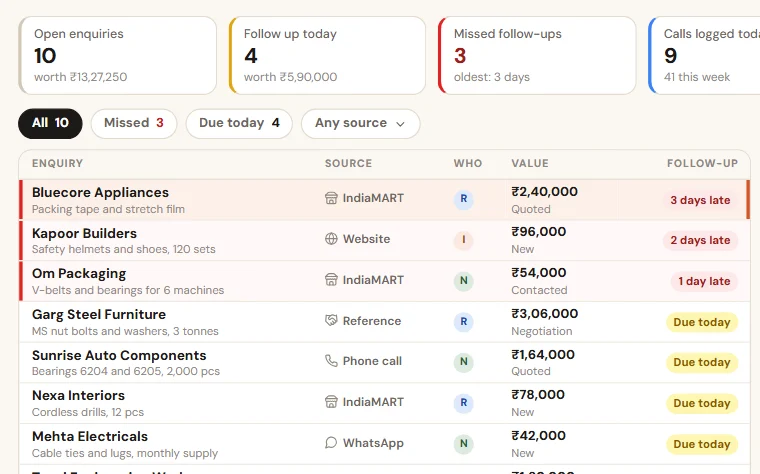
- Start the day with "due today". Each salesperson opens a filter view on their own name, with the follow-ups due up to today. Those calls come before new work.
- Keep a fixed gap when there is no response. For example day 1, day 3, day 7 and day 15. Change the gaps to suit your trade, then keep to them.
- Close honestly. After the last attempt, mark the enquiry lost with a reason: price, timing, bought elsewhere, no reply, not a real buyer.
- Review on Friday. Twenty minutes with the list: new this week, not contacted the same day, follow-ups missed, won and lost with reasons.
What to say in a follow-up message
"Any update?" gives the customer nothing to answer. Bring something new each time: a rate, a photo, a delivery date or a question.
Namaste, this is Rahul from Verma Hardware. You had asked about ball valves on Monday. We have the 1 inch size in stock. Shall I send rates for 250 pieces, or do you need another size?
Old enquiries deserve one more call
Once a month, filter the enquiries that were marked lost last month for "timing" or "no reply". Call or message each one once more, and leave out anyone who asked not to be contacted. A customer who was not ready then may be ready now.
Count it for one week
Do not guess how big the leak is. For one week, count four things:
- enquiries received, from all sources
- how many got a first reply within the hour
- how many were called the same day
- how many have a next follow-up date on Friday evening
These are your own numbers. Count again after a month of the routine and compare.
Sheet or system?
A shared Google Sheet with these eight columns is enough for one or two salespeople, as long as the owner opens it every Friday. It strains when enquiries arrive from many sources, when salespeople on the road will not open a sheet on the phone, or when you want to see missed follow-ups without asking anyone. At that stage we set up an Enquiry Follow-up system with a due-today list for each salesperson.
Want to see this on your own data?
Share last month of your data. We come back with a working demo. No payment for the demo.